Recap: AI-Powered Threats
In the first part of this blog series, we discussed the everyday cyber threats posed by threat actors leveraging AI to execute sophisticated attacks. In this part, we'll explore innovative AI-powered strategies that can help defend your organization.
Introduction
As the cybersecurity landscape evolves, AI continues to push the boundaries of what’s possible. Emerging technologies and trends are paving the way for more advanced and proactive defense mechanisms. In this part of the blog series, we examine what lies ahead for AI in cybersecurity and how it is shaping a more secure digital future.
Emerging Trends
- AI-Driven Deception Technologies
AI creates realistic decoys to mislead attackers, enabling security teams to gather intelligence.
Example: Honeypots that lure attackers into controlled environments for analysis.
- Quantum Computing and AI Integration
Quantum computing, combined with AI, promises breakthroughs in cryptography and threat detection.
Example: Development of quantum-resistant encryption algorithms using AI.
- Behavioral Biometrics
AI analyzes user behavior—such as typing patterns or device interactions—to detect anomalies.
Example: Continuous authentication systems that prevent account takeovers.
- Real-Time Threat Analysis
AI systems provide real-time threat analysis, identifying and mitigating threats as they emerge.
Example: AI-powered threat intelligence platforms that continuously analyze global threat data and provide real-time alerts.
- Predictive Threat Modeling
AI advances predictive threat modeling, enabling organizations to anticipate future attacks based on historical data and trends.
Example: Predictive analytics tools that forecast attack vectors and recommend preemptive defense strategies.
The Synergy of AI and Human Expertise
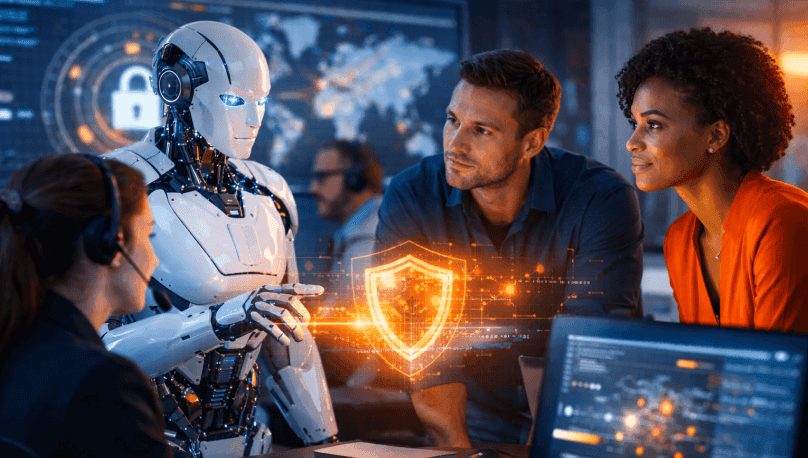
Although AI is a powerful tool, it cannot replace human ingenuity, creativity, and expertise. Combining AI with human intelligence creates strong synergies that enhance both sides of the AI-human collaboration:
- Augmented Intelligence
AI supports human analysts by automating tasks and delivering actionable insights.
Example: Security information and event management (SIEM) systems highlight critical incidents for human review and decision-making.
- Skill Development
Training programs are essential to equip security professionals with AI expertise.
Example: Certification courses focused on AI in cybersecurity are becoming central to professional development programs.
- Incident Forensics and Post-Mortem Analysis
AI sifts through massive amounts of log data and system interactions to pinpoint the root cause of a breach. Human analysts then interpret this data to understand the attacker's intent and methods, improving future defenses.
Example: AI identifies patterns in attack timelines, while analysts correlate them with known threat actors to build comprehensive forensic reports.
- Custom Security Policy Design
AI provides insights into organizational behavior patterns and common threat vectors, enabling humans to design tailored security policies.
Example: AI detects frequent user errors leading to phishing attacks, prompting analysts to adjust email filtering policies or implement additional training.
- Adversarial AI Detection and Mitigation
As cybercriminals adopt AI for malicious purposes, human expertise is crucial for interpreting and countering AI-driven threats.
Example: AI flags a sophisticated phishing campaign, while analysts investigate and deploy countermeasures to block similar future attempts.
These synergies highlight the importance of blending AI’s speed and precision with human creativity and strategic thinking to ensure robust cybersecurity.
The Importance of Continuous Evolution
AI—on both attackers' and defenders' sides—is continually evolving. This rapid progression requires organizations and regulators to stay informed about new developments and possibilities emerging almost daily. Collaborative research and partnerships are vital for advancing AI-driven cybersecurity solutions.
Moreover, ethical AI challenges must be addressed, including potential biases in AI models caused by current and historical data. Ensuring fairness in AI algorithms is essential to enhance both threat detection and decision-making processes.
Conclusion
The future of AI in cybersecurity is marked by innovation and collaboration. By embracing AI, organizations can protect digital assets, ensure compliance, and gain a competitive edge. In a world where threats are omnipresent, AI isn’t just an advantage—it’s essential for securing our digital future.